NS - Knowledgebase
Find the answers you need. More articles every week.
| ID | Title | Module | Category |
|---|---|---|---|
| 7 |
Configuring your ChartPro ServiceConfiguring your ChartPro ServiceChartPro is set up once and then largely left alone. The work is deciding what your chart notes should contain and in what order, which is done from ChartPro Administration. How a note is put togetherThree things stack up:
The Sections panel shows the five tabs with their segments beneath. Each segment has a short code and a number setting its position, and an Edit to open it. Add a Segment to this section adds a new one. 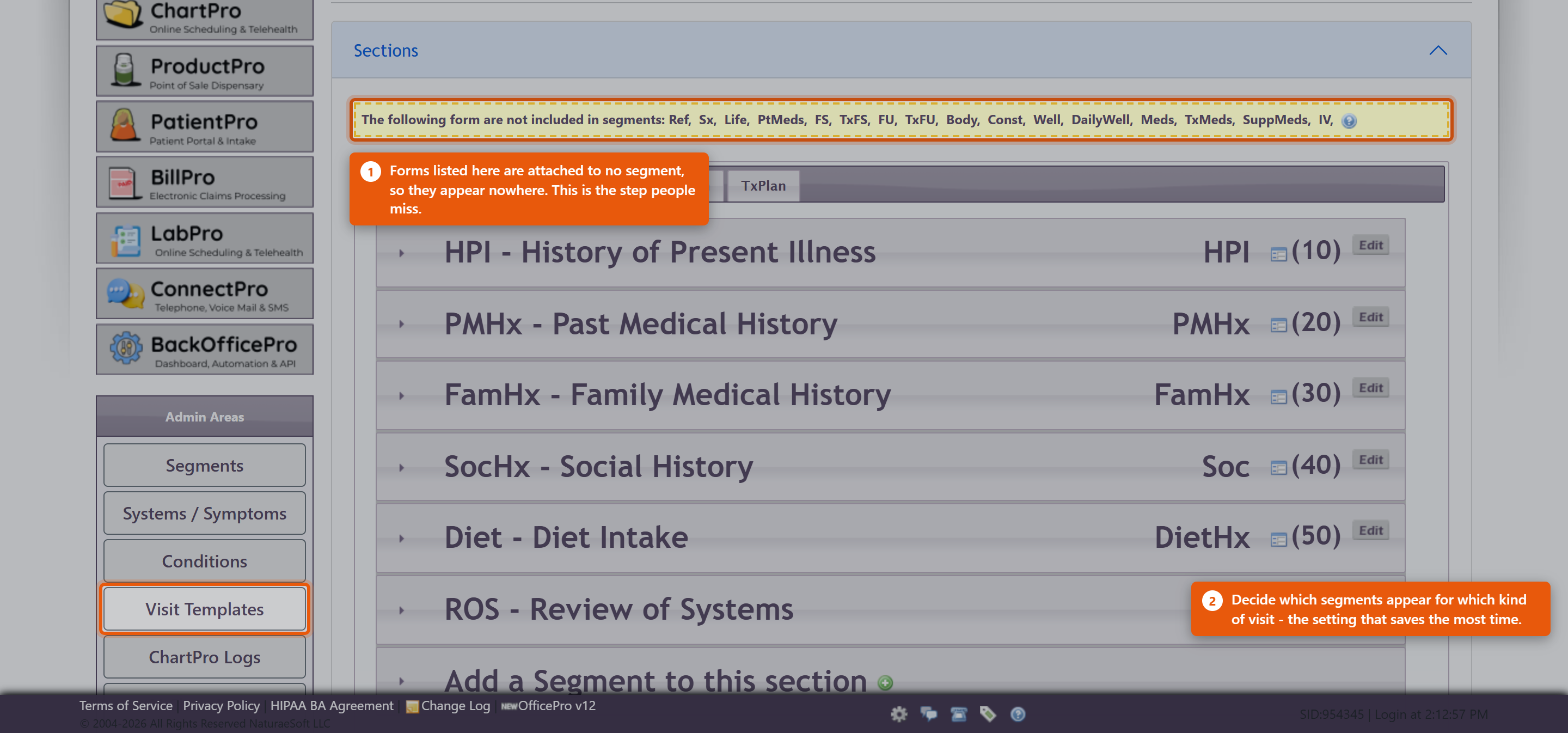 Setting up a segmentEdit Segment Details holds the name and description. Two settings matter more than they look:
Add to Templates puts the segment into your visit templates. The other admin areas
Getting startedDo not redesign everything before seeing patients. The supplied sections and segments are a working note for most practices.
A note designed in the abstract is almost always longer than the one you end up wanting. Practices giving IV therapyThe IV form is attached in exactly this way, and it is a common reason the IV panel appears to be missing. Enabling IV therapy in ProductPro settings is only the first step - the form still has to be attached to a segment here. See Setting Up IV Therapy Products. |
 |
|
| 100 |
Introducing ChartPro AI to Your PracticeIntroducing ChartPro AI to Your PracticeChartPro AI listens to a consultation and drafts the chart note from it. The provider then reads the draft and decides whether it goes into the record. There is nothing to install and no switch to turn on - it is available to every ChartPro practice, and it is marked BETA on screen. What there is to do is decide how your practice will use it, before a provider uses it in front of a patient. Decide about consent firstThis records a conversation with a patient. What you must tell them, and whether you need their agreement, depends on where you practise and is not something this article can answer for you. Settle it with whoever advises you on such matters, write down what your providers should say, and do that before the first recording - not after a patient asks what the phone on the desk is doing. The draft is a draftThe note is generated from a transcript of a spoken conversation. It can mishear, and it can be confidently wrong about a number or a name. The provider signing the note owns everything in it, exactly as if they had typed it. Make that explicit when you introduce it. The failure worth guarding against is not a bad draft - it is a good-looking draft accepted without being read. Start with a few willing providersIt suits some consultations far better than others. A structured follow-up transcribes well; a long, discursive intake with three people in the room is harder. Let a couple of providers try it on their own patients for a fortnight and report back before you roll it out. Watch the usage counterThe Auto Chart button shows each provider's use for the current calendar month against 40 - as a badge on the button and a bar on the recorder. It turns amber as it approaches and changes again past it. Going over does not stop anything. The counter is an indicator, not a gate: dictation keeps working. It is there so a provider can see their own pace, and so you can see who has actually adopted it. Review what it is writingReview past ChartPro AI encounters opens ChartPro AI - Encounter Review, which lists every encounter with its Date, Encounter # and Note Quality, and shows both the Transcript and the ChartPro AI Note side by side. Look through it a few times in the first month. Reading a transcript against the note it produced is the fastest way to calibrate how much your providers should trust it, and it is the only place you can see that. Ask your providers to rate notesEvery note can be rated, and almost none are - across all practices using it, a handful of ratings against hundreds of encounters. A rating on a note that came out wrong is worth far more than one on a note that came out fine, so ask specifically for those. |
|
|
| 37 |
Managing ChartPro Note SegmentsManaging ChartPro Note SegmentsAccess the ChartPro Admin Page:
View Existing Segments:
Add a New Segment:
Configure the New Segment: When adding a segment, you will need to fill in the following fields:
Save Changes:
Adjusting Segment Order
ConclusionThis process allows you to customize the charting experience in OfficePro by managing segments within the ChartPro admin page. Tailoring the segments to fit your practice's specific needs can enhance the efficiency and effectiveness of your documentation. |
|
|
| 103 |
Questions About ChartPro AIQuestions About ChartPro AIWhat does it actually do?It records the consultation, transcribes it, and drafts a chart note from the transcript. You read the draft and decide whether to keep it. Do we have to turn it on?No. It is there for every ChartPro practice, marked BETA, and there is no per-practice switch. What you do need is a decision about how your providers will use it. Is the note automatically added to the chart?No. Nothing is written until you accept the draft in AI Note Preview. Cancel discards it. Who is responsible for what it writes?The provider who accepts and signs it, exactly as with a typed note. Read the draft before accepting it - a draft that reads well is not the same as a draft that is right. Do we need to tell patients?You are recording a conversation with them, so treat that as you would any recording. What is required varies by where you practise - settle it with whoever advises you, and agree the words your providers will use before the first recording. What is the 40 on the button?Your notes for the current calendar month, per provider, shown against 40. The bar changes as you approach and pass it. What happens if we go over?Nothing stops. It is an indicator, not a cap - dictation keeps working and the count resets next month. Can we see what it wrote before?Yes. Review past ChartPro AI encounters opens ChartPro AI - Encounter Review, which lists them by Date and Encounter # and shows the Transcript beside the ChartPro AI Note. How do we tell whether it misheard or invented something?Read the transcript next to the note. If the transcript is wrong it is a recording problem; if the transcript is right and the note is not, report it. How do we get better results?Microphone nearer the patient, numbers and doses said clearly and in full, medicine names not abbreviated, the plan stated aloud at the end, and less background noise. Does rating a note do anything?Yes, and hardly anyone does it - a handful of ratings against hundreds of encounters. Rate the notes that came out badly and say why in the Comments; those are the ones worth reporting. Can we re-record?Yes - Go back and re-record from the preview, before you accept anything. It says no note was generated. Is it broken?Usually the audio had nothing usable in it. Check the transcript on the review screen first - that separates a microphone problem from an AI one. Which appointments suit it?Structured consultations transcribe well. A long discursive intake with several people in the room is harder. Try it on your own patients for a fortnight before deciding. |
|
|
| 20 |
Why can't I sign my chart note? The Sign and Document button is disabled.Why can't I sign my chart note? The Sign and Document button is disabled.Problem I am unable to sign my charts because the Sign and Document Chart Note button is disabled. Background Only when you are signed in to the Service as the Provider on record for the visit can you sign the chart. This means that you will not be able to sign the chart if:
Resolution
Further Assistance If you need more help with this issue please create a ticket contact support through live chat or by emailing Support@NaturaeSoft.com. |
|
|
| 6 |
Creating a Treatment PlanCreating a Treatment PlanA treatment plan is the document the patient takes away - what to do, what to take, and how. It is built from the encounter, and it prints as a clean patient-facing page rather than as a copy of your clinical note. Open the planOpen the plan from the encounter you are working in. It opens showing the document as the patient will receive it, with the patient's name, the date, you as provider, and a DRAFT watermark across it until it is finished. The list on the left, headed T:// TXPLAN, shows the sections the plan is made of. Which sections exist is set up once for the practice - see Configuring your ChartPro Service. 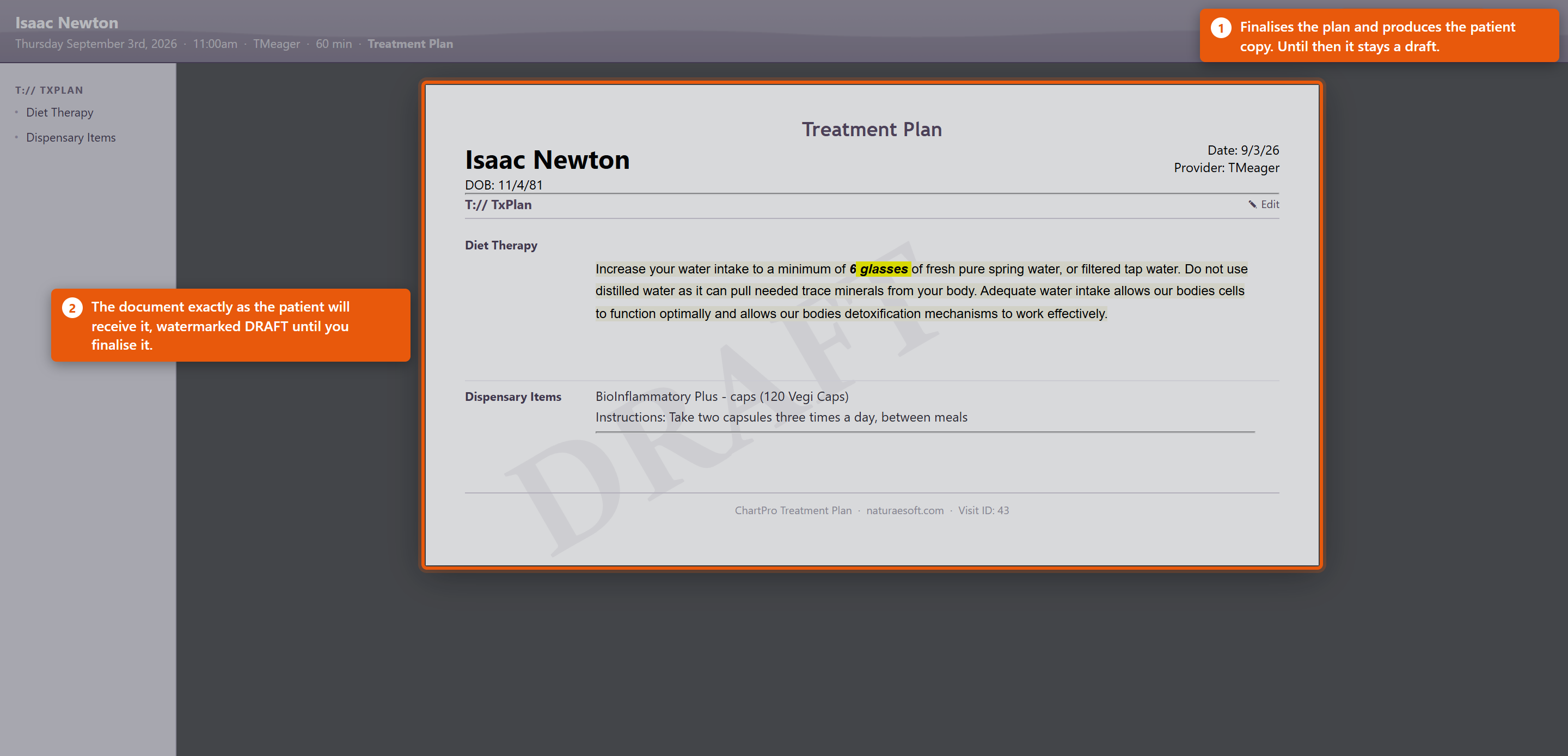 Fill it inEach section has an Edit pencil beside it. Click it, write the content, and it appears in the document straight away, so you are always looking at what the patient will see. Two kinds of section behave differently:
Finish itSave & Document finalises the plan and produces the patient copy. Close leaves it as a draft to come back to. A plan left in draft is not lost, but the patient has nothing - so finish it before the patient leaves rather than intending to come back to it. Making it useful
Dispensary items on the plan are the same products as in your catalogue, so the instructions can come from the product record rather than being typed each time. See Adding and Editing Products. |
|
|
| 101 |
Dictating a Note with Auto ChartDictating a Note with Auto ChartAuto Chart records a consultation, transcribes it and drafts the chart note. You read the draft and decide whether it goes in. Before you startOpen the note on the right visit - the AI is given that visit's Patient, Provider, Visit Type and Date of Service, and it uses them. Starting from the wrong visit produces a plausible note about the wrong context. Tell the patient what you are doing, in whatever words your practice has agreed. RecordingAuto Chart opens the listener and starts recording; you will hear a tone. The panel shows your use for the month against 40. Things that make the difference between a good draft and a poor one:
Reading the draftWhen it finishes you get AI Note Preview - Review the AI-generated chart note below. Read it properly. Check the numbers against what you remember, check nothing has been attributed to the patient that they did not say, and check nothing has been invented that sounds reasonable. A draft that reads well is not the same as a draft that is right, and once you accept it, it is your note.
Edit the note afterwards exactly as you would any other. The draft is a starting point, not a finished document. Rating a noteRate This Note asks about Transcription Accuracy, AI Note Quality and an Overall score from Poor to Excellent, with Comments, then Submit Rating. It genuinely is read - Your rating helps us improve ChartPro AI. Rate the ones that came out badly and say what was wrong in the comments. Almost nobody rates anything, so a specific complaint carries real weight. Looking back at what it wroteThe review link beside the button opens ChartPro AI - Encounter Review, listing your encounters by Date and Encounter # with their Note Quality, or Not rated. Opening one shows the Transcript next to the ChartPro AI Note. If you ever want to know whether it misheard something or invented it, this is where you find out. |
|
|
| 2 |
Creating your first Chart NoteCreating your first Chart NoteWelcome to ChartPro where you can easily and competently document your encounters with patients with ease. To get started, click on the [C] button in the visit icons area on any visit. The [C] button allows you to access the chart note for a particular visit. To learn more about visit icons and visit workflow click here.
Establish a Patient Visit:
Access the Chart Note:
Navigate to the ChartPro EMR Interface:
The ChartPro interface will load for this visit in a popup window and will put you right into the primary segment of the chart (usually, Subjective > HPI). The charting interface is organized in a compact but robust way to help you document your visits easily, accurately, rapidly, and effectively. To make the most of your charting experience familiarize yourself with the charting environment. Let's start with a description of the interface: Adding Content:
Incorporate Preformatted Content:
Complete Other Segments:
Save Your Note:
Additional Tips:
This guide should help you get started with creating chart notes effectively in OfficePro. |
|
|
| 102 |
Auto Chart Did Not Produce a NoteAuto Chart Did Not Produce a NoteWork through these in order. Most cases are the microphone or the room rather than the AI. The recorder will not startThe browser has to be allowed to use the microphone, and it asks once per site. If the permission was refused - or dismissed, which counts as refused - the recorder cannot start and will not ask again on its own. Clear that in the browser's site settings and reload. On a shared machine check you are in the profile you think you are. There is a companion article on granting microphone access for telehealth sessions; the browser side of it is the same problem. It recorded, but no note came backIf the review screen shows No AI note was generated for this encounter., the audio arrived and no note came out of it. Usually the recording had nothing usable in it - a microphone pointed at the wrong side of the room, or a session ended before anything was said. Open the encounter and read the Transcript. That tells you immediately whether the problem was the audio or the note: an empty or garbled transcript is a microphone problem, and a good transcript with no note is one to report. The note came back wrong or incompleteCheck the transcript first, for the same reason. If the transcript missed what was said, no amount of retrying will fix the note - change how you record:
If the transcript was good and the note was not, that is worth reporting: rate it and say what was wrong in the Comments. That feedback is read, and very little of it comes in. An error message on the review screen
The note went onto the wrong visitThe AI is given the visit you started from, so a note started on the wrong visit produces a note about the wrong context. Check the Patient, Visit Type and Date of Service in the preview before accepting it - that is what the header is for. If one has already been saved to the wrong chart, treat it as you would any misfiled note, and deal with it straight away. We are over 40 for the monthNothing happens. The counter is per provider per calendar month and it is an indicator, not a limit - the bar changes appearance and dictation carries on working. It resets at the start of the next month. The buttons are not there at allAuto Chart appears for ChartPro practices, on the chart note screen. If it is missing, check you are on a chart note rather than another screen, and that your practice has ChartPro. What to send supportThe Encounter # from the review screen, the date, the provider, and whether the transcript looked right. The encounter number is the one thing that makes an AI problem quick to look into. |
|